


Many Small and Medium-sized Enterprises (SMEs) have reached a critical point where their software is hindering growth, not helping it. What started as smart, independent purchases, a great CRM here and a powerful accounting package there, has evolved into a collection of scattered and often out-of-date systems.
This fragmentation is costly. Independent software systems lead to massive inefficiencies, data inconsistencies, and slow execution. For ambitious SME leaders in the Niagara Region and GTHA and beyond, this disconnect is the invisible ceiling limiting their profitability. The solution is simple: system integration.
The Multiplier Effect of Disconnection
When technology systems operate in silos, a simple business process becomes a complicated, error-prone chain of manual transfers.
Consider a common scenario: Sales promises a delivery date based on what they see in their CRM, but that data has not been updated from the separate Warehouse Management System (WMS). Operations then rushes to fulfill an impossible order.
This lag creates a negative multiplier effect:
- Wasted Time: Employees spend hours copying and pasting data between systems instead of serving customers.
- Customer Dissatisfaction: Mistakes, delays, and miscommunication damage client trust.
- Stalled Decision-Making: Financial teams cannot accurately calculate profit margins because component costs from the procurement system do not sync with the pricing engine.
The core problem is that your business data is never unified, forcing leaders to make decisions based on instinct instead of accurate, real-time data.
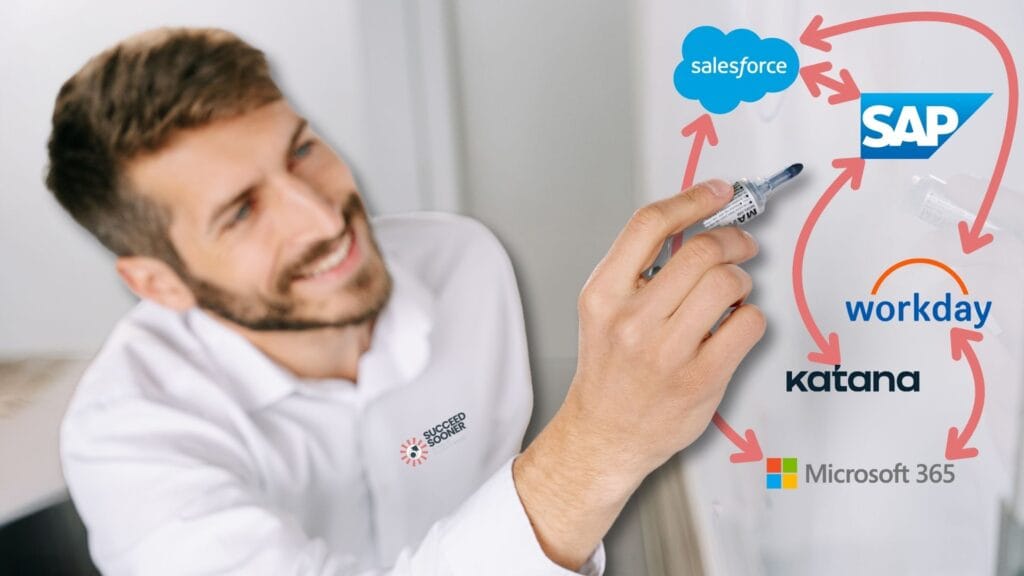
The Fractional CIO: Architecting the Unified View
The Fractional CIO‘s primary role in this context is to be the architect of the unified business view. They recognize that the total value of your technology stack is not the sum of its parts; it is the power of its connections.
Their approach is strategic and vendor-neutral:
- Strategic Blueprint: They begin by creating a comprehensive roadmap. This blueprint identifies the crucial points of data overlap and determines the precise integration strategy needed to eliminate manual data transfers.
- Smart Investment Strategy: They execute a rigorous “buy vs. build” analysis when selecting best-in-class software. This ensures you acquire tools that fit your functional needs and have the right APIs for seamless integration. This prevents over-investment in monolithic systems you do not need.
The result is a streamlined organization where information flows freely. Sales promises align with inventory reality, and financial analysis is instantaneous. This allows the organization to focus on high-value activities, dramatically increasing profit per employee and strengthening the sales-to-employee ratio.
The Foundation for Future Value
For growing SMEs, integrated data is not just an efficiency boost; it is the foundational enabler for all future technology value.
You cannot successfully implement modern solutions like process automation, AI solutions, or advanced analytics without a single source of truth. Automation projects fail if they rely on manual data clean-up. AI models deliver flawed results if the underlying data is inconsistent.
The Fractional CIO solves the integration problem first, building a rock-solid data foundation. By connecting the business today, they ensure you are positioned to leverage these advanced technologies tomorrow, securing your long-term success.
What’s Next
Are you and your team trapped in the daily grind of manual data transfer and solving avoidable communication issues? If your software systems are working independently, they are actively capping your profit potential.
The ability to move from intuitive decisions to data-driven decisions is essential for any SME aiming for long-term, scalable success. Integration is the step that makes that shift possible.
Do not let fragmentation continue to drain your time and capital. Let’s connect with Succeed Sooner Consulting to develop the strategic plan that turns your scattered systems into a powerful, integrated engine for growth.
Leave a Reply